
After attending 15 SuiteWorlds, I feel qualified enough to tell you that the product has gone through UI refreshes, architecture improvements, industry expansions, and analytics layers — all meaningful steps forward.
Each year has its theme — better analytics, faster performance, smarter workflows. But this year was different.
Somewhere in the middle of the keynote, the room shifted and you could feel this time the innovation was more substantial than ever before.
It wasn’t a new feature announcement.
It was the moment the purpose of NetSuite changed.
Up until now, ERP has fundamentally been a system of record — the place you go to look at what already happened. SuiteWorld 2025 was the first time NetSuite declared, in both architecture and intent, that it is becoming a system of action — a platform that doesn’t just store business logic, but executes it with you.
NetSuite Next: The Shift Wasn’t Subtle — It Was Structural
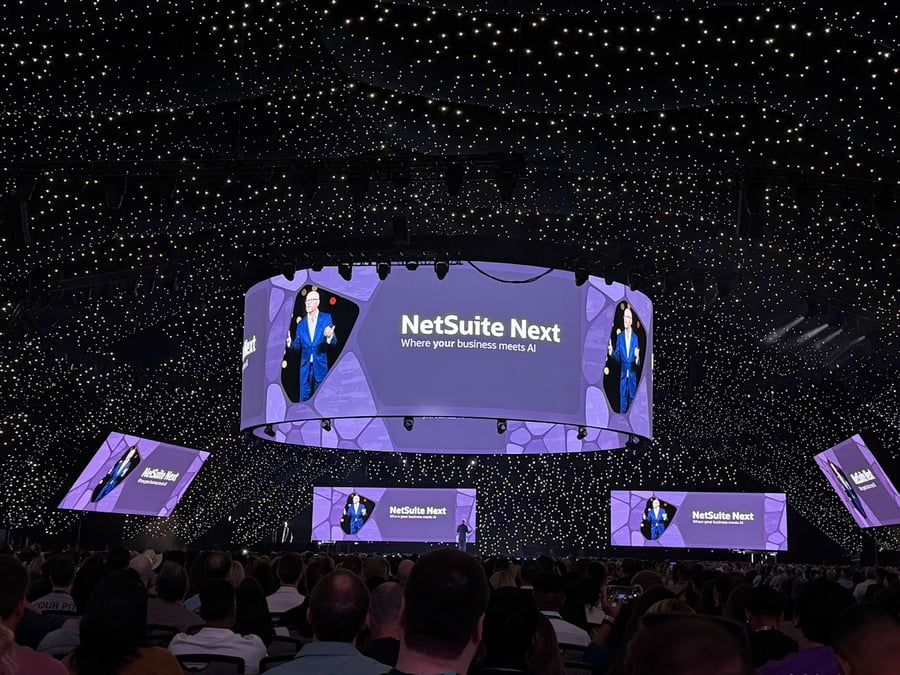
The new “NetSuite Next” vision was bold and the keynote message — “Where your business meets AI” — wasn’t positioning fluff. It was a signal that NetSuite is re-architecting itself around embedded, agentic intelligence. Not generative text “assistants,” not bolt-ons, not disconnected copilots — native system-level capabilities.
What struck me was how deliberate that message was. Not “AI bolted-on the platform.”
AI as the platform.
It’s an architectural shift, not a UI facelift.
The MCP Connector — Opening NetSuite to External AI Agents
One of the most quietly powerful announcements this year was the MCP (Model Context Protocol) Connector, which lets organizations connect external AI systems — including ChatGPT and Anthropic Claude — directly to their NetSuite environment.
For the first time, AI chat bots and agents outside the platform can converse with, query, and act upon ERP data through a controlled protocol.
That’s game-changing — but not friction-free.
Here’s the truth about adoption:
The MCP Connector unlocks innovation, but it also introduces a new class of risk that few companies are ready for.
|
Challenge |
What It Means |
|
Governance |
The AI executes as a NetSuite role — if roles are designed poorly, the AI can overreach. This is a real challenge for security leaders and administrators without the right strategy and guard-rails in place. |
|
Hallucination risk |
Natural-language fluency ≠ transactional accuracy. A convincing answer can still be wrong. |
|
Observability |
You must see what the agent did, not just what it said. Logging and review pipelines are mandatory. |
|
Latency & fit |
Excellent for exploration, queries, and summarization — not yet for high-impact actions or real-time orchestration. |
|
Change management |
Users trust visible interfaces more than invisible agents — adoption takes cultural design, not just API access. |
This is where the consulting partner becomes the safety layer.
Implementers used to configure fields and forms; now they must architect governance — defining what the agent can see, what it can change, and how it explains its reasoning.
That’s the new discipline of AI-ready ERP.
SuiteAgents + The Agent’s Toolbox — When the System Starts Building Itself
If the MCP Connector opened the door to external intelligence, SuiteAgents is what makes intelligence native.
The SuiteAgents framework turns NetSuite into a runtime where tasks, workflows, and actions are generated dynamically.
Administrators use the Agent’s Toolbox to define guardrails — context, allowed actions, and reusable logic — effectively teaching the system how to teach itself.
During the keynote, one example stood out:
A fictious SaaS company’s subscription-churn agent that didn’t just report rising churn but analyzed root causes (usage, billing cadence, service tickets) and proposed specific retention actions — such as issuing discounts, triggering outreach, or adjusting renewal terms — all within the platform.

Unlock Your Continued Success
Learn how to level up your NetSuite support strategy with insights from Techfino’s experts.
Download our Continued Success Whitepaper to explore proven methods for optimizing your system’s performance and scalability.
That’s not automation; that’s operational intelligence.
We’re moving from assistants that inform to agents that execute.
Bill.com — The First Native FinOps Agent
Bill.com’s appearance on stage was more than a partnership cameo. BILL announced its evolution from a standalone payables platform into a natively embedded FinOps Agent within NetSuite.
Its AI can now:
- Extract and classify invoices directly inside NetSuite.
- Match transactions to vendors and GL accounts automatically.
- Reconcile payments and update cash forecasts — without ever leaving the NetSuite context.
This is a pivotal signal: Similar to the MCP Connector, Oracle isn’t building a walled garden. Instead, they’re creating an ecosystem of cooperating agents, each specialized but context-aware. And for many, it’s a relief to know that SuiteAgents and partner agents will eventually operate side-by-side — a true marketplace of business intelligence.
Zero-Day Close
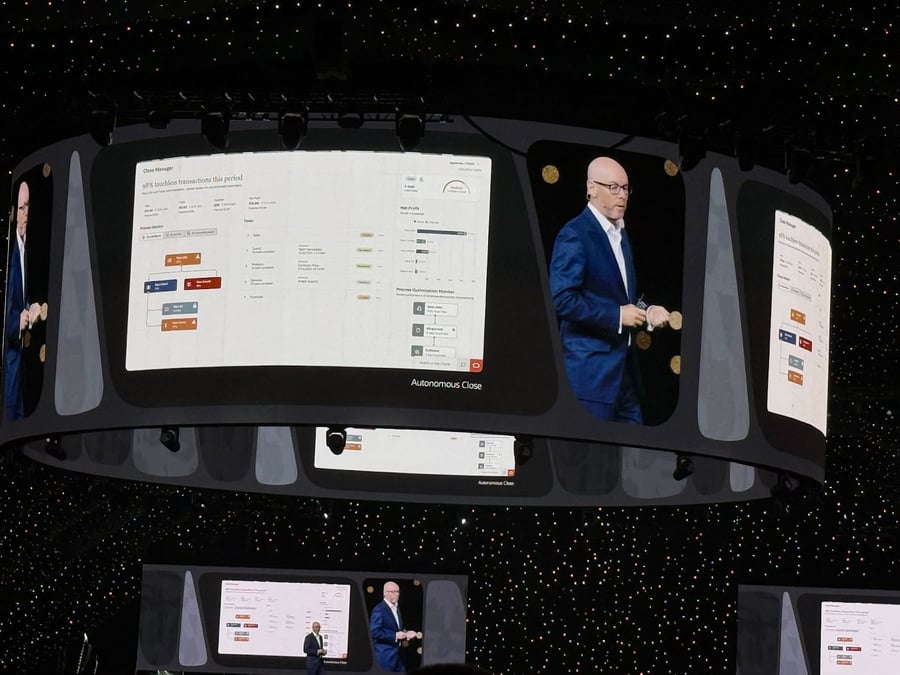
Finance was not left behind this year – at all.
The "Autonomous Close” teased by Evan Goldberg and the “Zero-Day Close” demo showcased continuous reconciliation — transactions validated in real time, exceptions surfaced automatically, and subledgers that always balanced.
The real insight, though, was what this enables: continuous forecasting.
When your actuals are always current, your predictive models stop being hypothetical.
Forecast accuracy improves because the data foundation never goes stale.
The close becomes a launchpad for foresight, not an endpoint.
It’s not “close faster.” It’s “close never.”
What This Means for Prospects and NetSuite Customers
Whether you’re evaluating NetSuite for the first time or you already run your business on it today, the decision landscape has changed. The question is no longer “Which ERP has the best feature set?” — it’s:
Which platform can safely act on my behalf — and how prepared am I to let it?
For prospects, this means selection is now about future capability, not current configuration. You’re choosing not just a system, but an intelligence layer that will mature with your business.
For existing NetSuite customers, this means the roadmap can’t just be “wait for new features.” Readiness has to be designed: governance, data hygiene, and partner alignment will determine how much of SuiteAgents or the MCP Connector you can actually use — and how safely.
The next competitive gap won’t come from who adopts AI, but from who is ready for it before it becomes table stakes.
Why Readiness Is Now Strategy
The shift to intelligent ERP isn’t about features; it’s about capabilities your organization must already have when those features arrive. It requires identifying real-world use cases where adopting AI can save time, money, and improve business outcomes.
That means clean data, strong governance, a culture of transparency, and partners who can architect AI guardrails as confidently as integrations.
This is why we’re developing the NetSuite Next Readiness Brief — a guide for leaders who want to understand what to modernize, what to protect, and how to pilot AI inside NetSuite safely and strategically.
If this resonated with you, you’re who we built it for.
Want Early Access?
If you’d like early access to the NetSuite Next Readiness Brief or to discuss what SuiteWorld 2025 means for your roadmap, please reach out for more information.
The next era of ERP won’t be won by who implements fastest — but by who prepares smartest.